INTERACTIVE READ-ALOUD · VIDEO & TRANSCRIPT
How to Teach Generosity Without Pretending Kids Don’t Like Stuff
Timmy Bauer’s newest read-aloud begins with an honest premise: kids—and adults—like getting things. Levi the Lion Learns Generosity uses that truth to explore what giving feels like and what money and possessions can be for.
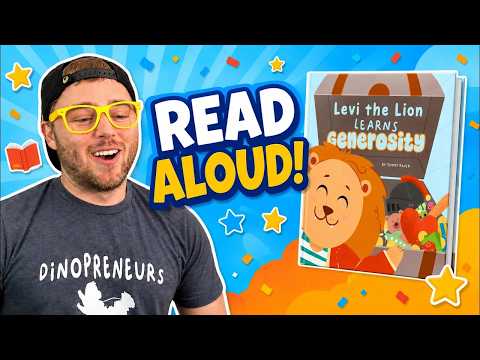
WATCH THE COMPLETE READ-ALOUD
Levi the Lion Learns GenerosityOpen the original video on YouTube ↗A lesson about generosity gets more believable when it does not begin by shaming children for wanting things.
That is the choice at the center of Timmy’s September 15 read-aloud. Before opening the book, he admits that he likes to get, buy, and collect stuff. Then he asks children whether they have ever given something meaningful to somebody who wanted it. The question creates a bridge between a familiar desire and a feeling they may not have words for yet.
What this read-aloud gives adults
- an honest opening for a conversation about wanting and giving;
- prediction and observation prompts children can answer while they watch;
- a story arc that lets generosity become an experience rather than a slogan;
- a way to connect money and possessions with purpose; and
- a small, concrete experiment children can try after the story.
Start With the Honest Objection
Levi does not begin as a secretly generous child waiting for the right speech. His father owns a treasure shop, and Levi hides the items he wants so customers cannot buy them. When his father explains that the shop sometimes uses its money to buy gifts for children in need, Levi hears only subtraction: if we give, we will have less.
Timmy makes that resistance part of the read-aloud. He tells viewers that he understands it and asks whether they have felt the same thing. That keeps the lesson from dividing the room into “good givers” and “selfish children.” Everyone can enter the story through a feeling they recognize.
Turn the Read-Aloud Into a Conversation
The video is not a silent recitation. Timmy repeatedly asks children to inspect the illustrations, predict what Levi will do, and name what they see. He points out the “mine” stickers Levi uses to hide merchandise, asks what Levi’s father might be planning, and pauses before the story’s important choices.
These prompts make the moral visible before it is explained. Children can notice that the shop is emptying, that Levi is protecting what he wants, and that his expectations about happiness are not working. The questions invite them to reason alongside the character.
Let Children Notice the Feeling
Levi’s father asks him to choose treasures for a family in need. Levi protects his favorites and gives only what he does not want. Even so, when he sees the recipients treat the gifts like priceless treasures, he is surprised by his own response: he is happy enough to cry, even though he did not receive anything.
The scene avoids treating generosity as a rule that must be obeyed before the story can continue. Levi experiences something, becomes curious about it, and tries to understand why giving affected him.
Make Room for the Relapse
The insight does not immediately transform Levi. Later, he earns money by helping in the shop and spends it on more and more things for himself. He becomes frustrated because the purchases do not recreate the happiness he felt while helping the family.
That backslide matters. Children are not asked to believe that one generous act erases the desire to own things. Levi still likes toys at the end of the story. What changes is his understanding of what possessions can do.
Name a Purpose for Money and Stuff
The decisive moment comes when Levi’s friend Lamantha wants a knight’s helmet as a birthday gift for her younger brother. Levi was about to buy it for himself, but he remembers the earlier experience and chooses to help her instead.
He traces the gift through a chain: his father received the shop, Levi received money, Lamantha receives the helmet, and her brother will receive the birthday present. His conclusion is the sentence Timmy returns to in the closing discussion:
“We get so we can give.”
The story’s faith-based framing is explicit. Timmy describes money as a tool for creating blessing and blessing other people. Adults using the video can name that framing directly and decide how to connect it to their family, classroom, or community.
Give Children a Safe Way to Try It
Timmy closes with an experiment rather than a comprehension quiz. He asks viewers to think of someone who wants something meaningful that they can actually give, then notice what happens inside their own hearts.
The scale can stay small. A child might share a toy, choose a book for a sibling, use part of an allowance to help someone, or give time and attention. The point is not to force a dramatic sacrifice. It is to let the child test the story’s claim through an act they can understand and own.
Watch and Continue
Read the complete video transcript7-minute timestamped transcript
COMPLETE TRANSCRIPT
Levi the Lion Learns Generosity
Lightly edited for punctuation and readability. Timestamps link to the original video.
0:00Today, readers, we’re going to be reading the story of a little lion who learns how to be generous. And if you’re like, ‘I don’t want to be generous. I hate being generous. I don’t want to give my stuff away to other people. That doesn’t sound fun at all,’ stay watching, readers, because you would be incredibly surprised.
0:11I really like stuff. I like to get stuff, buy stuff, collect stuff. My room is full of stuff. Is your room full of stuff? Now, here’s a question: Have you ever purposefully given some of your stuff away to somebody who didn’t have that kind of stuff and really wanted it, and it meant something to them?
0:26Ouch. Are you feeling like a stab-in-your-chest, stab-in-your-heart kind of emotion right now? Well, get ready, readers, because that’s exactly what happens to Levi the Lion in the story Levi the Lion Learns Generosity.
0:44In a small town, there was a treasure shop filled with exciting stuff. Here’s the thing, readers. I live in Central Florida, and there are all these gift shops surrounding that are filled with awesome stuff. And when you go through those gift shops, you’re like, ‘Oh my gosh, look at this. Oh my goodness, look at this.’
1:01And that’s what Levi’s doing, because his dad owns the shop. Levi was the prince of the treasures. His dad was the owner of the shop, and Jumpy, his defrog, was his deputy. What’s a defrog? Note to the readers: a defrog is kind of like a dog, but actually a frog.
1:17But Levi loved the treasure not for giving it to other people—for himself. Oh no, not Levi. Surely he’ll change. When customers would come into the treasure shop, Levi would hide his favorite gifts so no one would buy them.
1:34Suddenly, the shop was becoming very empty. The wind is rustling through the aisles. Dad wondered why. Uh-oh. Do you see what Levi’s doing? Levi is putting stickers that say ‘mine’ on the stuff that he doesn’t want anyone else to buy.
1:44‘Levi, these gifts are so people can buy them for others.’ ‘But Dad, if we let that happen, we’ll have less.’ What could Dad do to teach Levi the meaning of stuff? Dad had an idea. Is that a bag of coins in his hands and a list? Levi’s just pushing his car like, ‘What is Dad doing?’
2:04He pulled out a list of names and some money. He told Levi that he sometimes uses the store’s money to get gifts for kids in need. ‘But Dad, if we give our money to others, we’ll have less for us. Don’t you want to buy new things?’
2:20Dad must have a bunch of extra money lying around, Levi thought. Do you see what Levi’s imagining here? He’s imagining his dad buying a lawn mower, a car, a dishwasher. Those are the kinds of things that grown-ups dream about buying.
2:32Dad laughed. ‘I don’t give because I have extra, Levi. I give for a bunch of reasons. I’ve been given so much. Blessing others is the real purpose of stuff. Giving is one of the most fun things you can do with stuff.’
2:51Levi was barely even listening. Jumpy the defrog was trying to get him to pay attention, but it wasn’t working. ‘When we have a heart of generosity, God always takes care of our needs,’ Dad finished. ‘But Dad, I don’t just have needs. I want stuff, too. God gives me lots of things I want, too. I don’t see how it’s fun to give your stuff away,’ Levi said.
3:12Boy, I don’t know about you, but I can relate to Levi. I have felt this feeling so many times. Have you ever felt this feeling? ‘I didn’t at first either, Levi, but can I still have your help?’ It looks like Dad’s doing something clever.
3:23Here was Dad’s mission: Find the best treasures in the whole shop. ‘Yes!’ Levi said. ‘To give away.’ Ouch. Do you think that was easy for Levi? I don’t think so.
3:36Levi did what Dad asked, careful to only pick things he didn’t want for himself. For example, that knight helmet over there—he wanted that most of all to give to his deputy, Jumpy. They brought the gifts to the family in need.
3:51Then Levi looked in the window. He couldn’t believe what he saw. The kids treated those gifts like they were priceless treasures. Levi started to get emotional. ‘Dad, why am I so happy? I could cry from happiness.’ Have you ever wanted to cry from happiness before? ‘And I didn’t get the gifts.’
4:07Jumpy wanted to tell Levi the answer, but he couldn’t because he is a defrog. As time went on, Dad started trusting Levi more and started paying him for helping in the shop. What do you think Levi did with the money? Were you thinking he would buy stuff for others? Well, nope. He bought more for himself.
4:22More and more and more. ‘I don’t understand, Jumpy. I don’t feel as happy as the day we gave stuff to those kids. I feel frustrated.’ Does it look to you like Levi is understanding the lesson that his dad was trying to teach him? Let’s keep watching and find out.
4:38That’s when he remembered he finally had enough money to buy what he wanted most. ‘Everything’s about to change, Jumpy. We are going to be happy.’ Now, what do you think, readers? Do you think he’s going to be happy once he buys this thing? What do you think he’s going to do?
4:47Just as Levi was about to get it, his friend came into the shop looking at the very thing Levi was about to buy: a new knight’s helmet for Jumpy. No! Oh, one more thing: This is my friend Olivia. She’s going to be reading the parts of Lamantha the Lamb.
5:04‘Do I have enough money for this?’ ‘No, and it’s not for sale.’ Lamantha was very sad. ‘Oh man, I’m so sad.’ She explained that she wanted to give it as a birthday gift for her little brother, who has a pet dechicken. A dechicken is like a defrog, but a chicken. He loved his dechicken.
5:22Levi felt a pain in his gut. He thought about it, and he remembered how he felt when his dad let him give gifts away last time. Uh-oh. Are you thinking what I’m thinking? No. There’s no way Levi is about to do this.
5:33Before he could think about it, Levi ripped out his wallet. He grabbed some money. He grabbed the helmet. He gave them to Lamantha for her brother and his dechicken. Oh my goodness. Lamantha skipped out of the shop. She was so happy. ‘I’m so happy.’
5:50And Levi finally got it. ‘God gave my dad this shop. Dad gave us money. We gave Lamantha the knight’s helmet, and she’s going to give it to her brother, who’s going to give it to his dechicken.’ Readers, have you gotten the point of the story? If you haven’t gotten it yet, Levi’s about to say it.
6:04‘We get so we can give.’ He’s starting to understand this whole thing about money being a tool that is used to have blessing, to create blessing, to be a blessing, to bless others. That’s the whole point of money. We think it’s all about buying stuff, but it’ll never make you happy.
6:19Levi didn’t stop liking toys, but he had a whole new understanding of the purpose of stuff. Readers, do we have a whole new understanding of the purpose of stuff now? ‘From now on, Jumpy, we’re going to use our treasures and our money to bless other people like crazy.’
6:34Readers, I know this sounds really crazy, but this is one of the only things that you have to experience or you’re not going to understand it. So I challenge you, if you’re watching this and you’re like, ‘I don’t want to do that,’ give it a try.
6:42Find somebody that you know who wants something that would mean a lot to them if they could have it, that you could actually give them, and give it to them. See what happens inside your heart. It’s crazy. Dad beamed because he was so proud of his son’s generosity.
6:55That was Levi the Lion Learns Generosity. I hope you liked it. If you did, you need to check out my super-secret club of Dinopreneur learners called DinoPreneurs. Just go to dinopreneurs.com, or ask your parents to help you, or go to the link in the description.
7:08You can get a big brain like Levi, learn how to earn money that you can then use to create blessing and bless other people with it. Check it out. I’ll see you in the next video.